 Insider know-how
Longtail boats: romance at the expense of your health? Exhaust, pollutants and the environment
15 min readUpdated:
The longtail boat is the image many people associate with southern Thailand: a slim wooden boat, colourful ribbons at the bow, a long shaft at the stern. It is romantic and part of the coast's culture. Less visible is what happens at the other end: the drive is often a converted vehicle engine that runs right next to the passengers and blows its exhaust into the air above the water. This article explains what is in such exhaust, what the International Agency for Research on Cancer (IARC) and the WHO say about it, what research on boats in Thailand shows and where that knowledge ends. We sell an alternative and therefore have an interest. That is why we also state what is not proven, and we do not invent measurements.
Contents
The key facts
These points are backed by the cited sources. Everything else in the article is context.
- Since 2012 the IARC has classified diesel engine exhaust as carcinogenic to humans (Group 1) and petrol exhaust as possibly carcinogenic (Group 2B).
- Soot (black carbon), fine particles and ultrafine particles enter the lungs when inhaled. Ultrafine particles can reach the alveoli.
- For longtail boats in Krabi we found no measurements of passengers or crew. Nothing reliable can therefore be said about the dose of a single trip.
- Skippers and crew carry the highest exposure. Children, pregnant women, older people and people with asthma, COPD or heart disease should be especially careful.
- Motorboats also burden the environment: noise, exhaust and damage to coral from engines and mooring on the reef are documented in Thailand's marine parks.
Romance at the bow, engine at the stern
The longtail boat gets its name from the long drive shaft with the propeller at its end. The engine stands open at the stern or amidships, often without any cover. In Thailand converted engines from cars and trucks, diesel or petrol, are often used for this. Such an engine is not built to run close to people, and as a rule it has no exhaust after-treatment such as the particulate filter or catalytic converter of modern road vehicles.
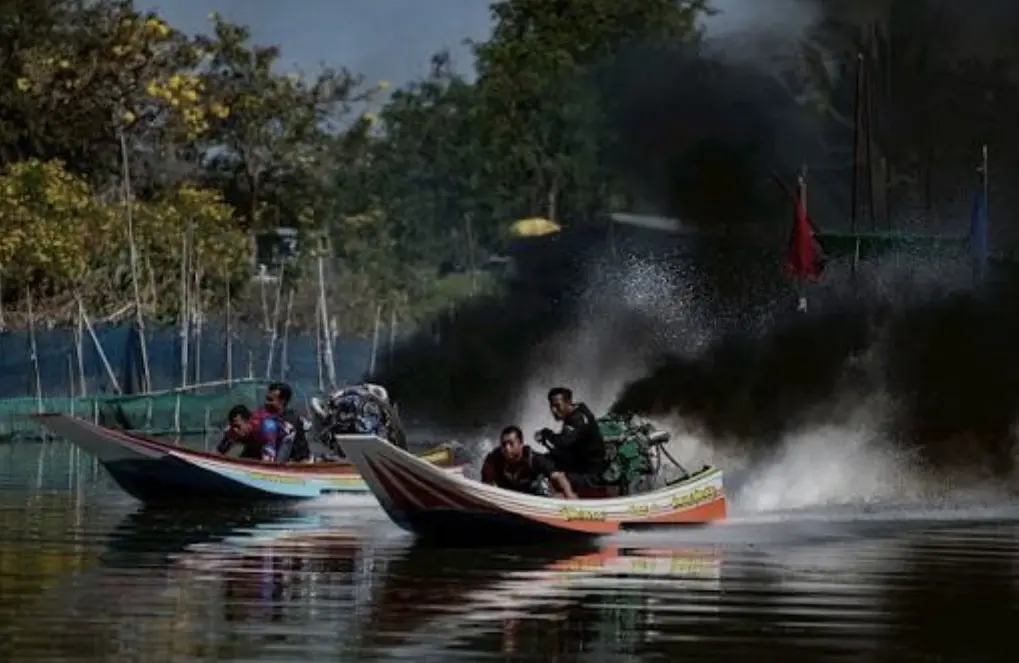
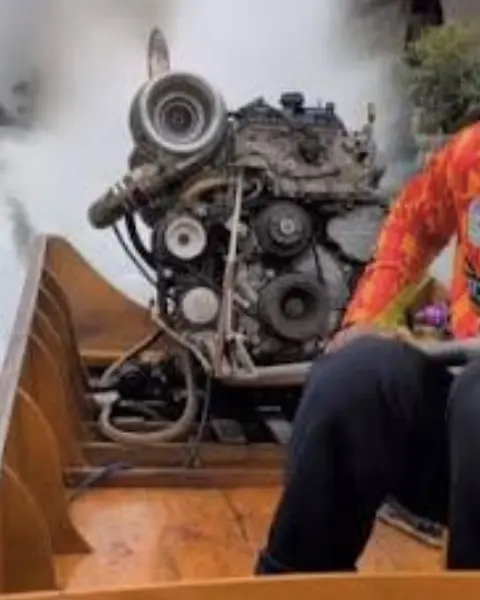
The pictures in this article show longtail boats with a dark plume of smoke and an engine with a turbocharger. They do not come from tours in Krabi, and these are evidently heavily tuned boats. They therefore do not show a typical tour boat. They do show how visible soot can become when a diesel engine runs under load.
What is in engine exhaust
The exhaust of a combustion engine consists of gases and particles. The gases include carbon monoxide, nitrogen oxides and volatile organic compounds. The particles include soot (black carbon), fine particles (PM2.5) and ultrafine particles with a diameter below 100 nanometres. Further substances cling to the particles, among them polycyclic aromatic hydrocarbons (PAHs). How much of it is produced depends on the engine, fuel, maintenance and load.
In a 2012 report the WHO describes black carbon as a component of fine particles that forms during incomplete combustion. According to its review, studies show an association between daily variations in black carbon concentration and short-term health effects, and between long-term exposure and mortality from cardiovascular and lung disease. Toxicology suggests that soot may act less as a toxic agent itself and more as a carrier for other chemicals into the lungs and blood.
Diesel exhaust is classified as carcinogenic
In June 2012 the IARC, the WHO's cancer agency, classified diesel engine exhaust as "carcinogenic to humans" (Group 1). The basis was sufficient evidence of a link to lung cancer, plus limited evidence for bladder cancer. The IARC rates petrol exhaust lower, as "possibly carcinogenic" (Group 2B). A trigger for the re-evaluation was, among others, a US study of underground miners. A 2018 review reports that re-analyses of two large studies confirmed the original findings.
Important for putting this in context: the classification says that a substance can cause cancer, not how large the risk is at a given dose. The studies concerned people with years of exposure at work. A single boat trip is not comparable. For skippers and crew who stand next to the engine every day, the picture is different from that of a guest who rides once.
Nanoparticles and fine dust: why the lungs are affected
According to a review of their physicochemical properties, ultrafine particles are so small that they can reach the finest regions of the lung (the alveoli) and bypass the airways' first lines of defence. The same work notes that harmful effects of PM10 or PM2.5 are often attributed to the ultrafine fraction. In its 2021 air quality guidelines the WHO lowered the annual guideline for PM2.5 from 10 to 5 micrograms per cubic metre and highlighted black carbon and ultrafine particles as important topics.
Soot and particles irritate the airways and can trigger coughing, shortness of breath or asthma attacks in sensitive people. Risk groups include children, pregnant women, older people and people with asthma, COPD or heart disease. This is general medical knowledge about air pollutants, not a measurement on a boat in Krabi.
What research on boats in Thailand shows
For longtail boats in Krabi specifically we found no measurements of passengers or crew. That is a gap. The nearest source is a project by the Climate and Clean Air Coalition (CCAC) with the Asian Institute of Technology on boats on the canals and the Chao Phraya in Bangkok. It found that boats with 15 to 20 year old engines emit a lot of black smoke when leaving and approaching piers and contribute to Bangkok's air pollution. The emissions of this sector had not been studied separately before.
In model calculations of the same project, switching to engines meeting the Euro VI standard with low-sulphur fuel would cut PM2.5 emissions by about 98 percent, while cleaner fuel alone with the existing engines would cut them by only about 5 percent. This concerns Bangkok's canal boats and cannot be transferred one to one to Krabi. It does show that above all the engine decides, not the fuel. The project's participants also note that the overall effect may be small, but that people living along the water and the boat operators are likely to be affected most.
What this means for guests
Put honestly: a single trip on a longtail boat does not, on today's knowledge, lead to cancer in healthy adults. The risk arises from dose and duration, and duration mainly concerns the crew. For guests, complaints in the moment are possible: smell of exhaust, an irritated throat, headaches, shortness of breath in sensitive people. There is also the noise of an open engine, which makes a trip tiring even without exhaust.
If you are sensitive, or travel with small children, pregnant women or people with breathing or heart conditions, you should keep these points in mind. And if you are attached to a romantic moment, you can have the romance another way: quieter, without a plume of smoke, at a distance from strangers' groups.
Our speedboat: modern Suzuki power, just for your group
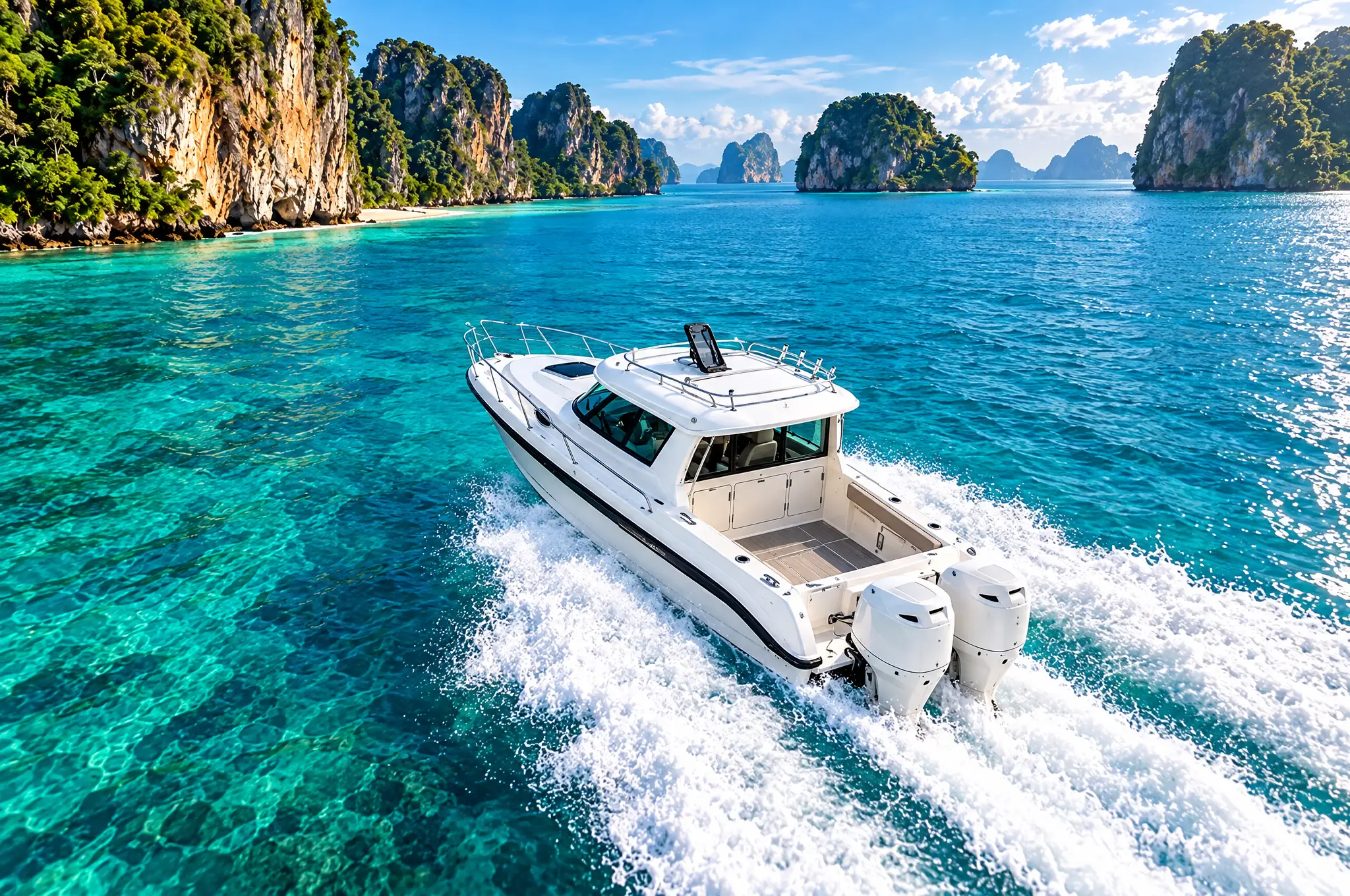
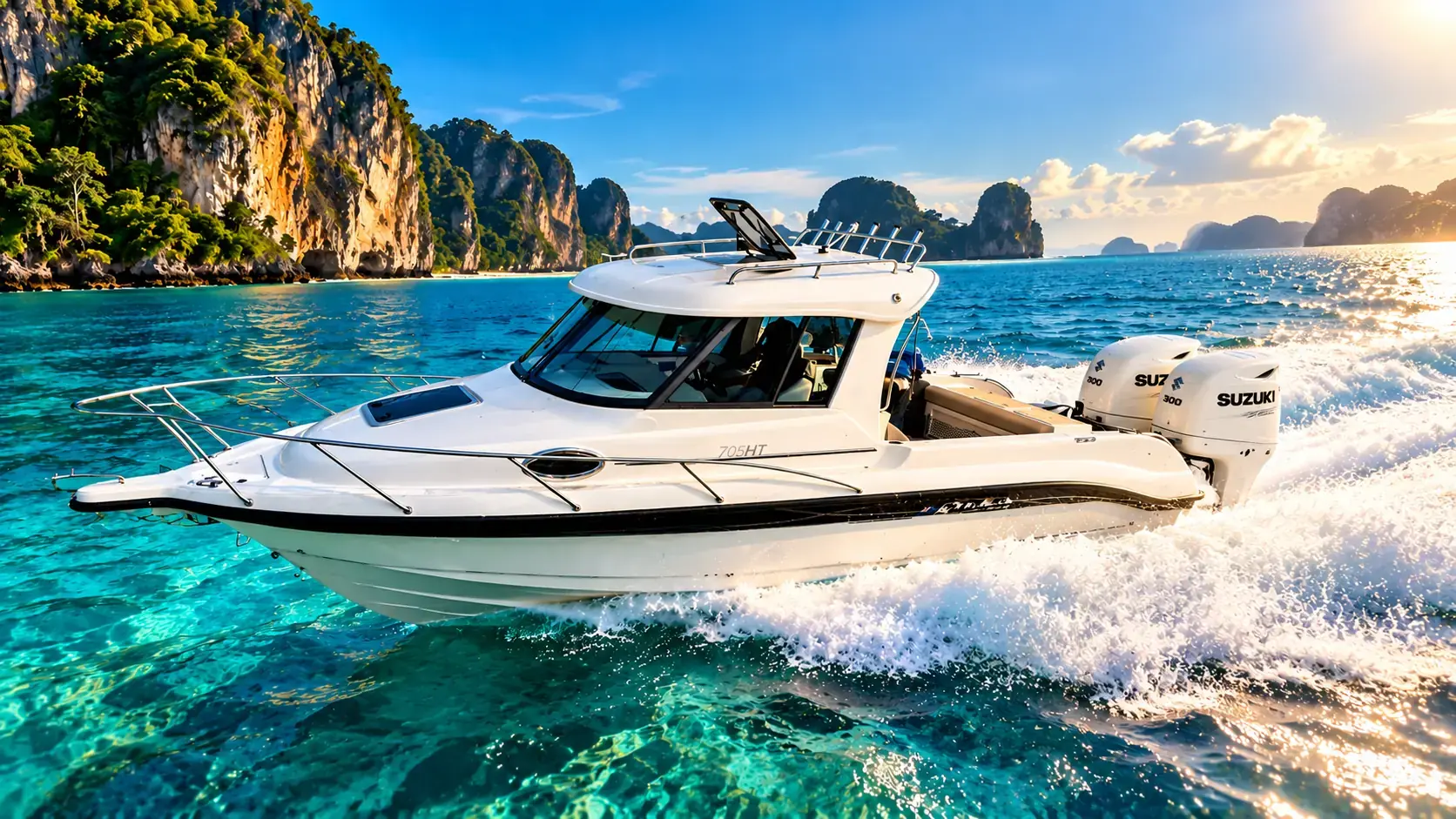
We do not run a boat with a converted vehicle engine. Our private speedboat runs on two modern Suzuki outboard engines (300 hp each, 4.0-litre V6 four-strokes), developed for use on boats. According to the manufacturer, the Lean Burn technology of these engines adjusts the air-fuel mixture via an oxygen sensor in the exhaust to reduce consumption and emissions. On top of that, the boat is yours alone for the day, together with up to 5 guests: no strangers, no changing boats, no waiting for others. You decide departure time and pace, and we adapt seating and route if you are sensitive to exhaust or travel with children.
The price is per boat for up to 5 guests. Some islands and national parks charge an entrance fee that is not included in the tour price and is paid on site directly to the rangers. The start is possible in Ao Nang or Krabi Town.
Environmental protection: what motorboats do at sea
Exhaust and noise are not only a matter for people. Consequences of boat traffic are documented in Thailand's marine parks. A park official explained in 2018 that over about 20 years boats mooring in Maya Bay had damaged reefs and disturbed the sand. The bay was therefore closed to boats. According to a 2024 report, on average about 120 boats, including longtails and speedboats, enter Pileh Bay every day. Air pollution from exhaust, noise and a higher risk of accidents are cited. The authorities therefore banned empty longtail boats from parking in the lagoon and from transferring guests from speedboats.
Mooring on the reef is also considered damage. From Koh Kradan it was reported that a boat was tied to coral although a buoy was available, which led to legal action against its owner. Corals grow slowly: some species need decades or longer. This is not specific to longtails but a risk of any motorboat without buoys and rules.
On noise: studies show that motorboat noise can affect the behaviour and reproduction of some reef fish. In a Great Barrier Reef study, nesting male fish spent more time chasing other fish and less time guarding their young when boat noise was played. A 2021 review describes noise as a growing stressor on coral reefs but notes that most studies cover only a few fish species and that the effect depends strongly on species, life stage and type of noise. For corals themselves we found no direct measurements.
On fuel and oil that reach the water from longtail boats, we found no published measurements. In general, spilled fuel and oil harm marine life. Ask every operator how it handles refuelling, oil changes and bilge water.
What to clarify before you book
Especially for families, pregnant women and people with breathing or heart conditions, a short check is worthwhile before you book a boat.
- Which engine drives the boat (diesel or petrol, age, outboard or converted vehicle engine)?
- Where do guests sit in relation to the engine, and how can the distance be increased?
- Does the boat visibly smoke black when accelerating or leaving the pier? If so, better do not ride on it.
- Does the boat travel with other groups, and how many boats are at one destination at the same time?
- Is there safety equipment, and are buoys used instead of anchors at reefs?
- How does the operator deal with fuel, oil and waste?
Sources
The health statements rest on these sources. Where they state limits, we have kept them in the text.
- IARC: diesel engine exhaust carcinogenic to humans (Group 1), press release of 12 June 2012 (PAHO reprint: paho.org/en/news/13-6-2012-iarc-diesel-engine-exhaust-carcinogenic)
- Review in the American Journal of Epidemiology (2018) on the re-evaluation of the diesel studies (pmc.ncbi.nlm.nih.gov/articles/PMC5982841)
- WHO Europe: Health effects of black carbon, 2012 (who.int/europe/publications/i/item/9789289002653)
- Ultrafine particles: unique physicochemical properties relevant to health and disease (pmc.ncbi.nlm.nih.gov/articles/PMC7156720)
- Climate and Clean Air Coalition / AIT: emissions inventory for inland water transport in Bangkok (ccacoalition.org, project "Developing an emissions inventory for inland water transport in Bangkok")
- Suzuki Marine: outboard product page (globalsuzuki.com/marine/lineup/df300ap)
- Khaosod English, 6 February 2024: Krabi rushes to handle 120 tourist boats a day to Pileh Bay (khaosodenglish.com)
- Phuket News: Tour boats blamed for widespread reef damage (thephuketnews.com, Koh Kradan)
- Arab News / AFP, 2018: Once-pristine Thai bay from "The Beach" to close to boats (arabnews.pk/node/1246341)
- University of Exeter: Ecological implications of motorboat noise on coral reef fish communities (ore.exeter.ac.uk/repository/handle/10871/120368)
- Ferrier-Pagès et al. (2021): Noise pollution on coral reefs? A yet underestimated threat to coral reef communities (review)
Frequently asked questions
Is longtail boat exhaust carcinogenic?
The IARC classifies diesel exhaust as carcinogenic to humans (Group 1) and petrol exhaust as possibly carcinogenic (Group 2B). Longtail boats often run on converted diesel or petrol engines. The risk depends on dose and duration and mainly concerns the crew, not the guest of a single trip.
Are there measurements on longtail boats in Krabi?
We found no measurements of passengers or crew on longtail boats in Krabi. A project on boats in Bangkok is known, which describes old engines with a lot of black smoke.
What are ultrafine particles?
Particles with a diameter below 100 nanometres. According to a review they can reach the alveoli and bypass the airways' first lines of defence.
Is a single longtail trip dangerous?
For healthy adults not, on today's knowledge, in the sense of a cancer risk. Complaints in the moment are possible, such as the smell of exhaust, an irritated throat or headaches, and in sensitive people shortness of breath. The noise of an open engine comes on top.
Who should be especially careful?
Children, pregnant women, older people and people with asthma, COPD or heart disease. They should keep away from the engine or choose a quieter alternative.
Is your speedboat emission-free?
No combustion engine is emission-free, ours included. Our boat runs on two modern Suzuki outboard engines (300 hp each, 4.0-litre V6 four-strokes), developed for use on boats, not on a converted vehicle engine. The boat is your group's of up to 5 guests for the day.
What does a private boat tour cost?
With us from 18,500 THB per boat for the 4 Islands, for up to 5 guests and not per person. An entrance fee at some islands is paid on site to the rangers and is not included.
Which pollutants do longtail boats emit?
Like any combustion engine: carbon monoxide, nitrogen oxides, volatile organic compounds and particles such as soot, fine particles (PM2.5) and ultrafine particles to which further substances such as PAHs cling. How much depends on engine, fuel, maintenance and load. We found no measurements for longtail boats in Krabi.
What is the difference between diesel and petrol exhaust?
The IARC classifies diesel exhaust as carcinogenic to humans (Group 1) and petrol exhaust as possibly carcinogenic (Group 2B). Both contain pollutants. Diesel engines generally emit more soot when they run under load without a particulate filter.
What is soot (black carbon)?
A component of fine particles that forms during incomplete combustion. According to a 2012 WHO report, variations in concentration are linked to short-term health effects, and long-term exposure to mortality from cardiovascular and lung disease. Soot can also carry other chemicals into the lungs and blood.
What are PAHs and why do they matter?
Polycyclic aromatic hydrocarbons form during incomplete combustion and cling to particles. Some of them are considered carcinogenic. How much longtail boats emit we do not know, as we have no measurements.
What are nanoparticles in exhaust?
Ultrafine particles with a diameter below 100 nanometres. According to a review they can reach the alveoli and bypass the airways' first lines of defence.
Is carbon monoxide a problem on an open boat?
In the open air carbon monoxide dilutes quickly; the danger exists mainly in enclosed spaces. Directly behind or beside an engine the concentration can be higher. We have no measurements for longtail boats.
Does the wind dilute the exhaust at sea?
In the open air exhaust dilutes more than on a city street. Right at the engine, when pulling away and in the boat's wind shadow, exposure can still be high. Sit as far from the engine as possible and into the wind.
How close do guests sit to the engine of a longtail boat?
On many longtails the engine stands open at the stern or amidships, with the benches in front of it. The distance is often small. It depends on the boat: ask before the trip where you can sit.
What does black smoke from the exhaust mean?
Black smoke indicates a lot of soot and incomplete combustion, for example under high load, with poor tuning or an old engine. The CCAC project in Bangkok describes a lot of black smoke from 15 to 20 year old boat engines when leaving and approaching piers.
How do I recognise a heavily smoking boat?
Watch a boat at the pier when it pulls away: a dark plume behind the stern indicates high soot levels. If you see that, choose a different boat or ask for a different engine.
How great is the risk for children?
Children breathe faster and are more sensitive to air pollutants. A single trip is not a cancer risk, but exhaust, noise and heat can burden them more. Seat children far from the engine and give them breaks on land.
What applies to pregnant women?
Pregnant women are among the groups who should be especially careful. Talk to your doctor before a boat tour and choose a quiet boat with distance from the engine.
What applies to asthma, COPD or heart disease?
Air pollutants can worsen symptoms. Take your medication, avoid the exhaust stream and ask your doctor beforehand. Tell the operator about your sensitivity before booking.
How great is the exposure for skippers and crew?
It is highest, because they work next to the engine every day for years. The IARC classification rests on studies of people exposed at work. We found no measurements for crews in Krabi.
Can boat noise damage hearing?
Permanently loud noise can strain hearing. We have no measurements for longtail engines. An open engine is loud and makes conversation difficult. Earplugs can make sense for children and sensitive people.
Do longtail boats damage coral reefs?
Motorboats harm reefs mainly by mooring on coral, anchors, grounding and traffic. A park official named engines and mooring as the cause of damage in Maya Bay in 2018. This applies to every motorboat, not only longtails.
What happens to fuel and oil at sea?
For longtail boats we found no published measurements. In general, spilled fuel and oil harm marine life. Ask operators how they handle refuelling, oil changes and bilge water.
How does boat noise affect marine animals?
Studies show that motorboat noise can affect the behaviour and reproduction of some reef fish. At the level of whole fish communities the findings are mixed and species-specific. For corals themselves we found no direct measurements.
How many boats enter Pileh Bay?
According to a 2024 report on average about 120 per day, including longtails and speedboats. Exhaust, noise and accident risk are cited. Empty longtails are no longer allowed to park in the lagoon or transfer guests from speedboats since.
Is a speedboat more environmentally friendly than a longtail?
Every motorboat burns fuel. Our boat runs on modern Suzuki outboard engines instead of a converted vehicle engine, it is one boat for your group of up to 5 guests and runs with no strangers' group on board. We cannot quote a measured environmental advantage.
Are there electric or lower-emission boats in Krabi?
Technically they exist. We have not found it documented that they are widely offered for trips in Krabi. We do not offer electric boats. The CCAC project in Bangkok calculates that modern Euro VI engines could cut PM2.5 emissions by about 98 percent.
What can I do as a guest to protect the sea?
Do not touch or stand on coral, do not feed fish, leave no waste, insist on boats that use buoys instead of anchors at reefs, use reef-friendly sunscreen and follow the national parks' rules.
Do special rules for boats apply in the national parks?
Yes, and they change. In Maya Bay, for example, boats may not enter the bay, and there are visitor limits and a closure period. Check the current rules before the trip. More in the guide on the opening dates of Maya Bay.
How do I choose a responsible boat?
Look at engine type and age, distance from the engine, visible smoke, group size, safety equipment, buoys instead of anchors and the handling of fuel, oil and waste. Ask before you book.
Experience this place privately
Private speedboat from Ao Nang for a maximum of 5 guests – route and timing planned around the tides and your wishes.
These private tours visit the places in this article.
 6 hrs · from 1 pm
4-Islands VIP & Sunset Special
The famous islands – but when the crowds are gone.
from ฿18,500 per boat · max. 5 guests
 7 hrs · from 8 am
Hong Island Secret Lagoons & Hidden Bays
Emerald lagoons and bays no group boat visits.
from ฿21,500 per boat · max. 5 guests
 8 hrs · from 7 am
Phi Phi Early Bird – before everyone else
Maya Bay, Pileh Lagoon and Bamboo Island in the first morning light.
from ฿28,500 per boat · max. 5 guests